Guide11 min read
Is my mechanic overcharging me? How to check a car repair estimate
A step-by-step guide to reading a repair quote: what's normal, the red flags worth asking about, your rights, and how to get a fair second opinion before you say yes.
 By SpotaLabs Team
The phone rings. The car you dropped off for "a grinding noise" needs pads, rotors, a brake fluid flush and an alignment, and the total is more than you expected. You're standing in a parking lot trying to decide whether to say yes.
That moment is where most people feel the least in control of their car. You don't have a lift, you can't see the part, and you don't know what the job should cost. This guide is about getting that control back. It covers how a repair estimate is put together, what a fair one usually looks like, the specific things worth questioning, and how to get a second opinion without starting a fight with your shop.
How a repair estimate is built
Almost every estimate, from a dealer or an independent shop, is made of the same five pieces. Once you can see them separately, the total stops being one scary number.
- Parts. Each part with a quantity and a price. Shops buy parts at trade prices and sell them at a markup. That's normal and is part of how shops make money. What matters is whether the part is what you expected (new, OEM, aftermarket, remanufactured) and whether the price is in the normal range.
- Labor. Usually hours × the shop's hourly rate. Most shops don't bill the minutes the technician actually spent. They bill book time: the standard time a labor guide lists for that job on your car. If the guide says a front brake job takes 1.5 hours, that's what you pay, whether the tech finishes in an hour or in two.
- Fees. Shop supplies (rags, cleaners, small hardware), hazardous-waste disposal, and sometimes an environmental fee. These are common and usually small.
- Diagnostics. A charge for finding the problem, often one hour of labor. Many shops credit it toward the repair if you go ahead.
- Tax. Depending on your state, on parts, labor or both.
Hourly rates vary a lot: dealers usually charge more than independent shops, and big-city shops more than rural ones. Because of that, the most useful single question you can ask is simple: "What's your hourly labor rate, and how many hours are you billing for each job?"
Step by step: checking your estimate
1. Get it in writing, itemized
Before you approve anything, ask for a written, itemized estimate: every part, every labor line with its hours, every fee. A single line that says "Brake service – $884" is impossible to check. Many states give you the right to a written estimate. California, for example, requires one for most repairs and doesn't allow the shop to go over it without your authorization.
2. Separate the jobs
An estimate often bundles several jobs. Split them up in your head (or on paper):
- the repair you came in for (the grinding brakes),
- anything the shop found while it was in there (a leaking hose),
- maintenance it recommends (fluid flushes, filters, an alignment).
Each job should make sense on its own. Ask which one fixes your actual complaint.
3. Check the labor hours, not just the rate
A fair hourly rate with too many hours is still too much. If two jobs overlap, the labor should overlap too. Replacing front pads and front rotors at the same time shouldn't be billed as two full, separate jobs, because the wheel and caliper come off once. Ask: "Is the labor for these two jobs combined, or billed separately?"
4. Look at what's marked "recommended"
Words like recommended, suggested, advised or at customer's request mean the shop thinks it's a good idea, not that the car needs it today. Recommended items aren't bad. Some are genuinely worth doing while the car is already apart. But they're the easiest place to save money, or at least to postpone a cost.
Compare recommendations with your owner's manual maintenance schedule, not a generic chart. Many fluids and filters last longer than the "every 30,000 miles" rule of thumb, and some are "lifetime" fills under normal driving.
5. Price the big items
Look up typical prices for the one or two lines that make up most of the bill. Parts are easy: search the part number or the job for your exact year, make, model and engine. For whole jobs, compare the price with a typical range for your car, keeping in mind that dealers and independent shops have different ranges.
6. Ask to see the evidence
A good shop is happy to show you why a part needs replacing:
- Brakes: the pad thickness and rotor measurements, or the rotor's minimum thickness compared with what was measured.
- Tires and alignment: the tread depth readings and the "before" alignment printout showing it's out of spec.
- Leaks: a photo of the leak, or the part itself.
- Fluids: a test strip result, or the mileage since the last change in your records.
You can also ask for your old parts back. In many states you have that right if you ask when you authorize the work, so ask up front and have it written on the work order.
7. Get a second quote for the same work
If a big job still feels high, get a second quote. The trick is to make it a fair comparison: give the second shop the same list of work, without the first shop's prices, so it quotes the same job rather than a different one. Then compare line by line: parts, hours and fees.
Red flags worth asking about
None of these prove anything on their own. Each one is a reason to ask a polite question.
- No itemization. One lump sum for "repairs" with no parts or hours.
- Pressure to decide now on work that isn't about safety ("this price is only good today").
- Vague urgency with no measurement behind it: "your brakes are really bad" instead of "your front pads are at 2 mm."
- Lots of fluid flushes at once, especially ones your manual doesn't call for at your mileage.
- Parts replaced in pairs or sets that don't need to be. Some should be (brake pads and rotors per axle), some shouldn't.
- Labor hours that look high for the job, or that don't overlap when jobs share the same disassembly.
- The final bill is higher than the estimate and nobody called you to approve the difference.
- Reluctance to show the old part or a measurement.
When a higher price is fair
Sometimes an estimate is above the usual range for good reasons:
- Better parts. OEM or premium pads and rotors cost more than economy ones, and usually last longer or are quieter.
- Your car. Performance brakes, all-wheel drive, European cars and big trucks often cost more to work on.
- Your area. Labor rates in big cities can be far above the national average.
- Rust and seized parts. Old bolts that need heat or cutting add real time.
- A warranty. Shops that stand behind their work for longer sometimes charge more for it.
If one of these explains the gap, you may be happy to pay it. The point is knowing which one it is.
Questions to ask your shop
Keep these handy. They're polite, specific and hard to answer with a shrug.
- What's your labor rate, and how many hours is each job?
- Which of these fixes the problem I came in for?
- Which items are safety-related, and which can wait? What happens if I wait?
- Can you show me the worn part or the measurement?
- Are these parts OEM or aftermarket? What's the warranty on parts and labor?
- Is the labor combined for jobs that share the same work?
- Could the rotors be resurfaced instead of replaced, or are they below minimum thickness?
- Can I have my old parts back?
- Will you call me before doing anything that isn't on this estimate?
Doing all of this with EngineEar Repair Check
Most people don't do all seven steps, because it takes an evening and a lot of searching. We built Repair Check in EngineEar so you can do it in a few minutes, in the parking lot, before you call the shop back. Here's what that looks like with a sample brake estimate.
Scan the estimate
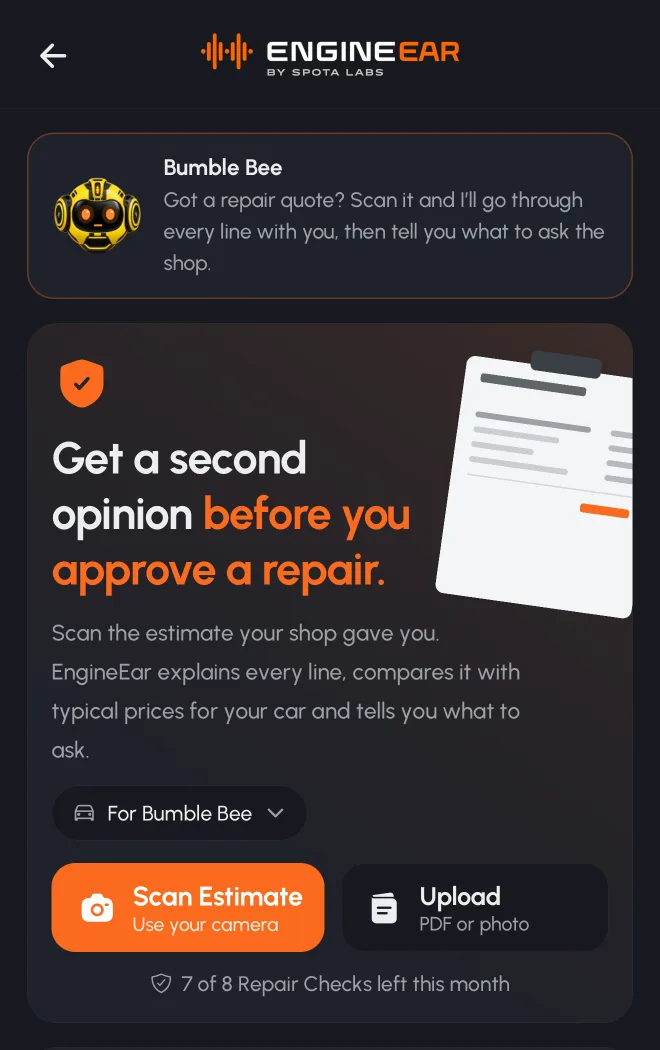
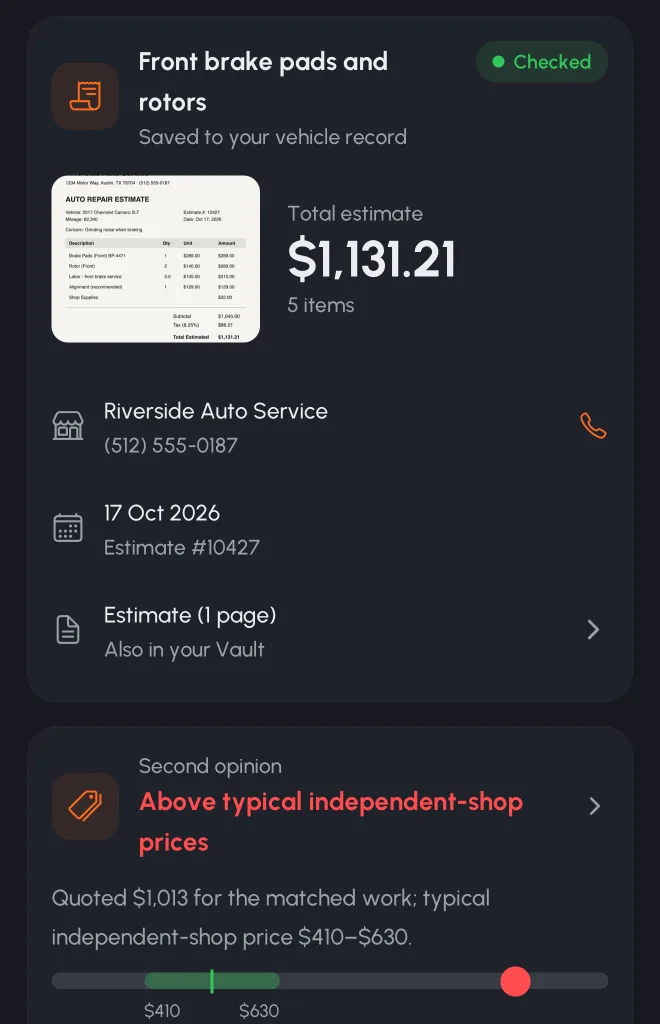
Open Repair Check, choose the car and scan the paper estimate with your camera, or upload a photo or PDF. EngineEar reads every printed line (parts, labor, fees, tax, the shop's details) and you check them before anything is saved. It only records what's printed. It never adds or invents lines.
See how it compares with typical prices
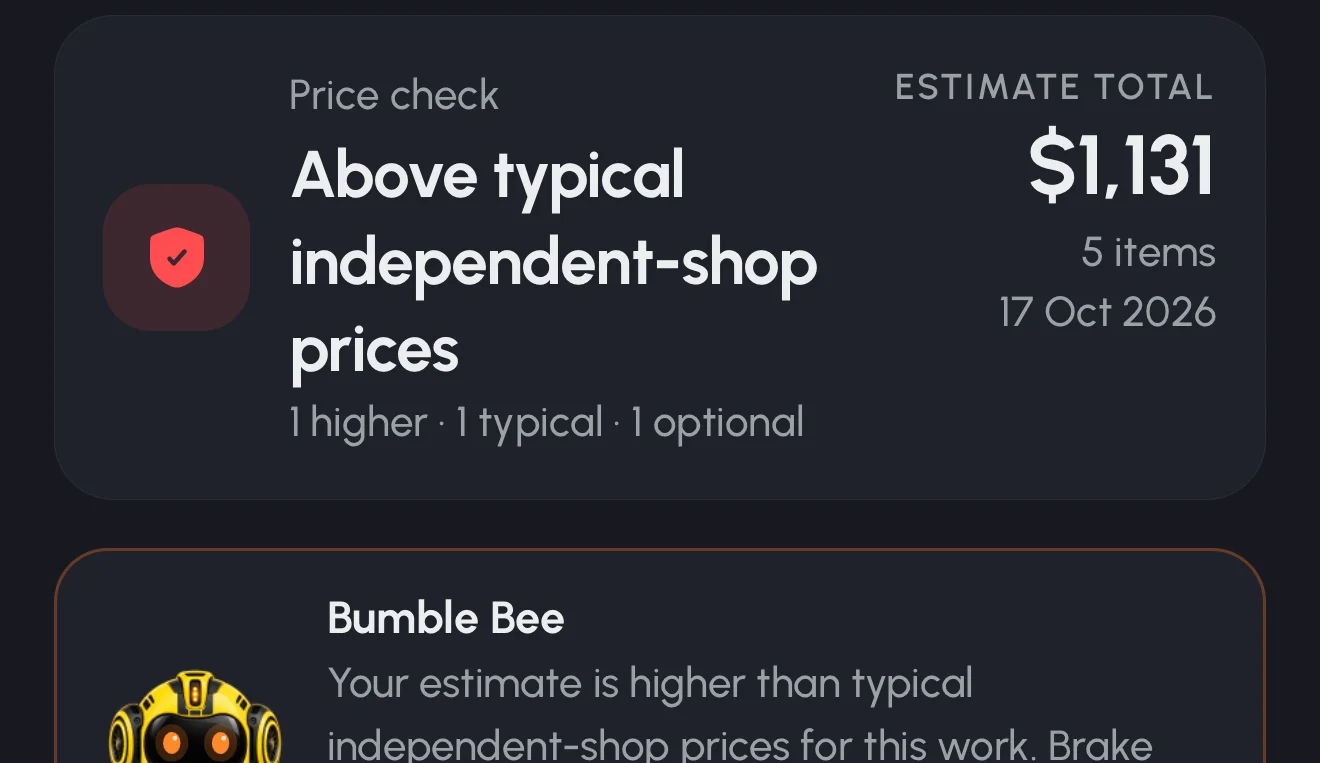
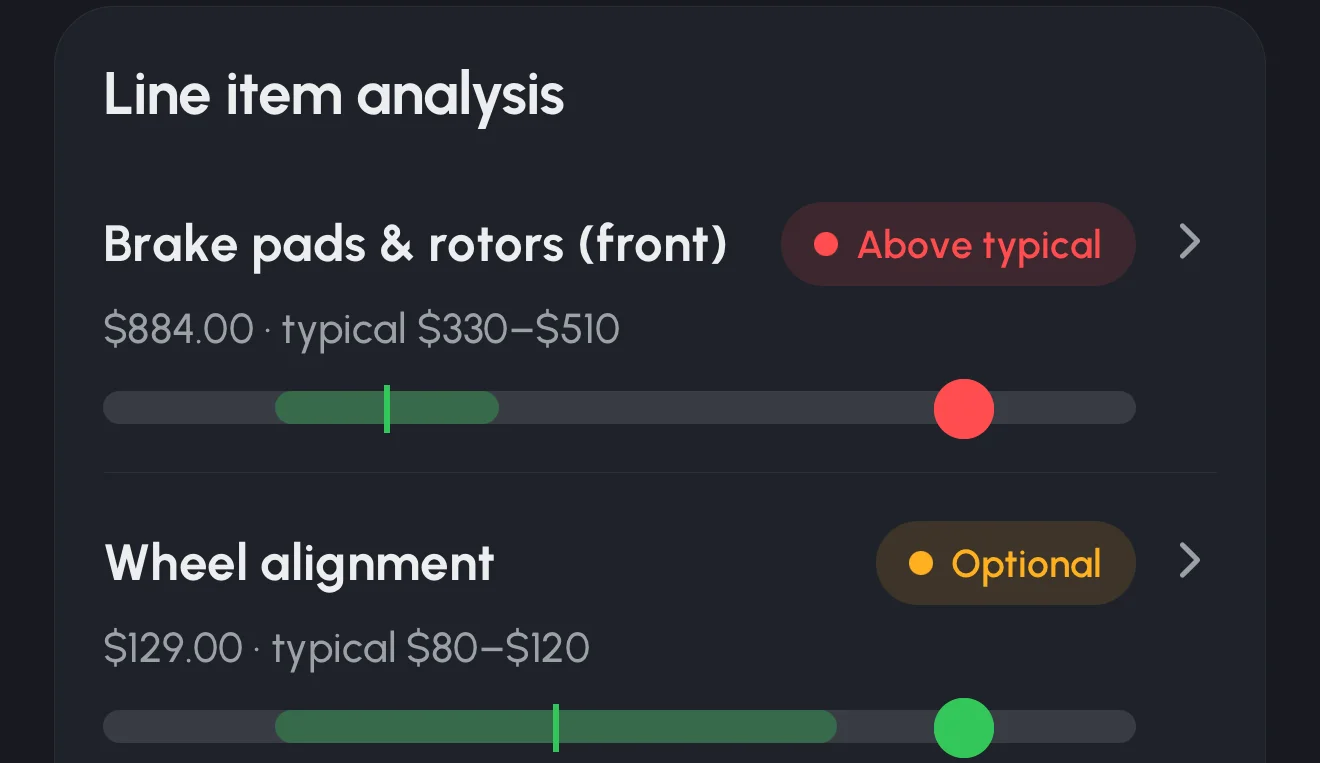
Repair Check matches each line to a known job and compares the quote with typical price ranges for your year, make and model, for both independent shops and dealerships. Each job gets a plain verdict: within, above or below typical. Jobs that belong together, like front pads and rotors, are priced as one job, the way a shop would do them.
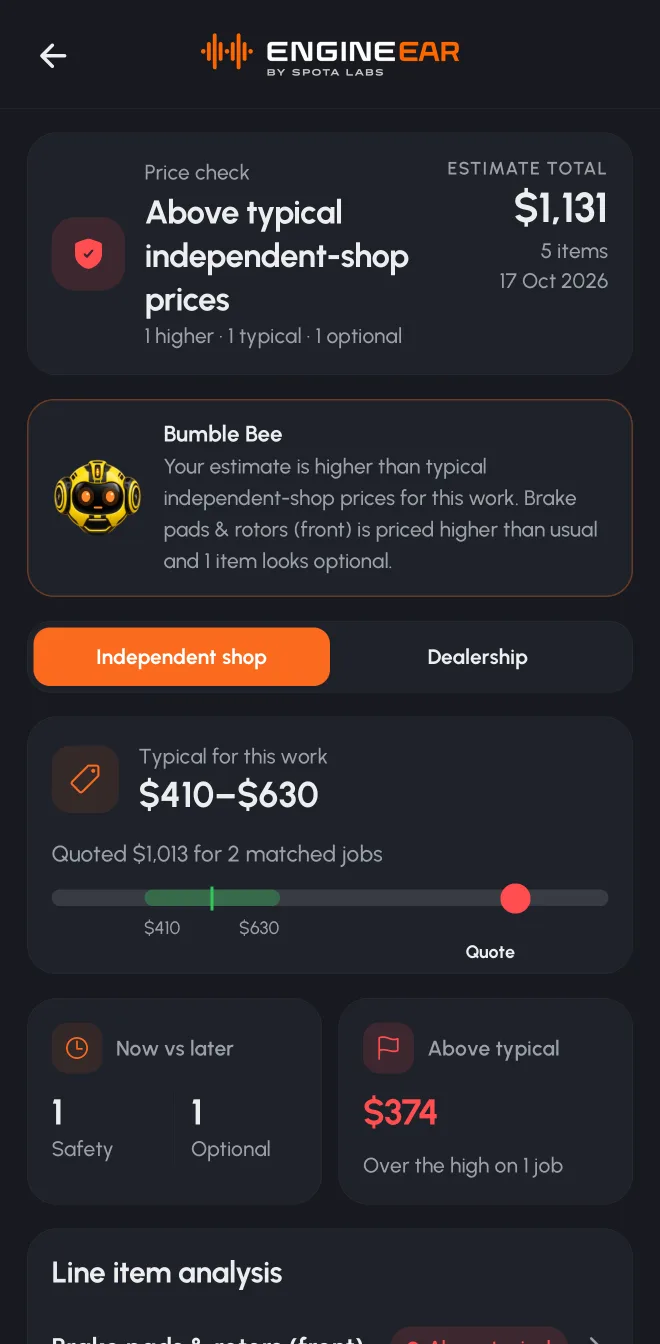
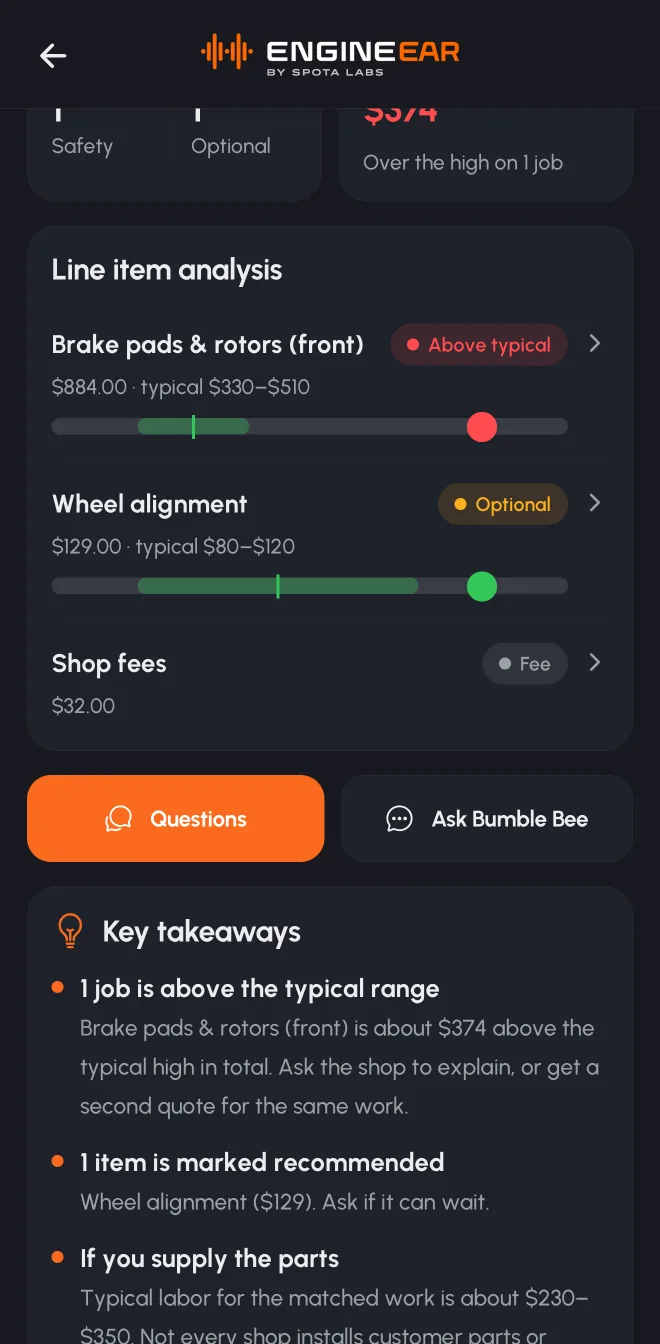
In this example, the brake job is above the typical independent-shop range, the alignment is a recommendation rather than a repair, and the shop fee is a normal fee. That's exactly the kind of picture that's hard to see from a single total.
Know what to ask, and what can wait
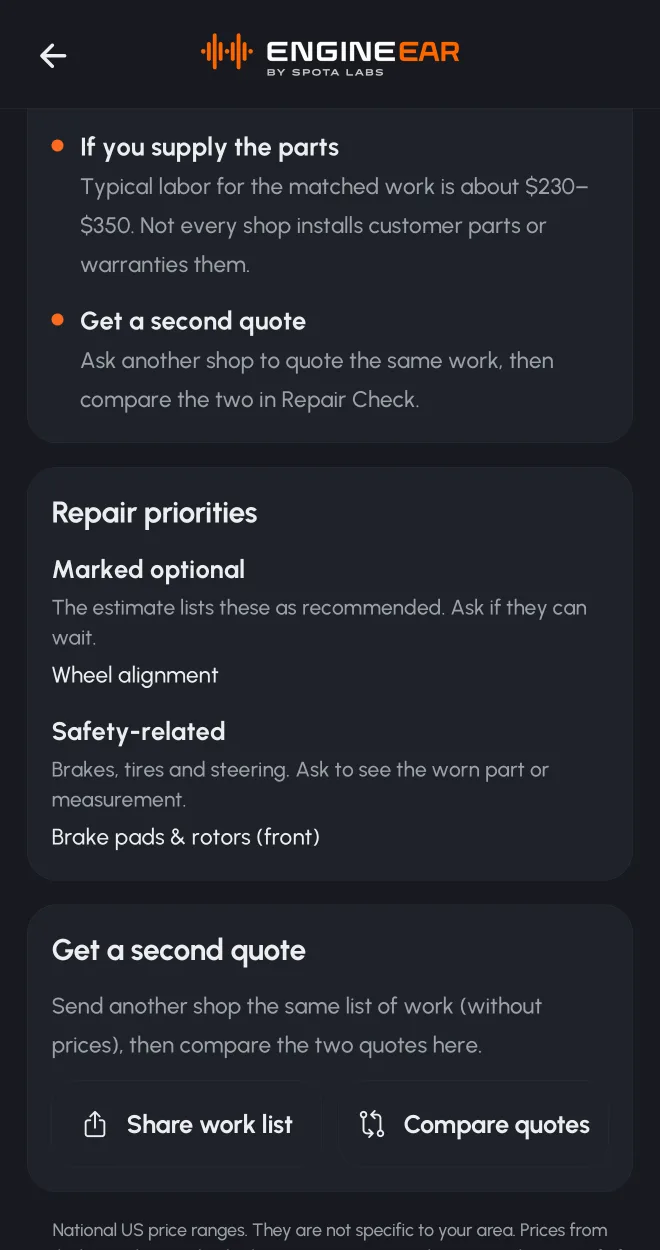
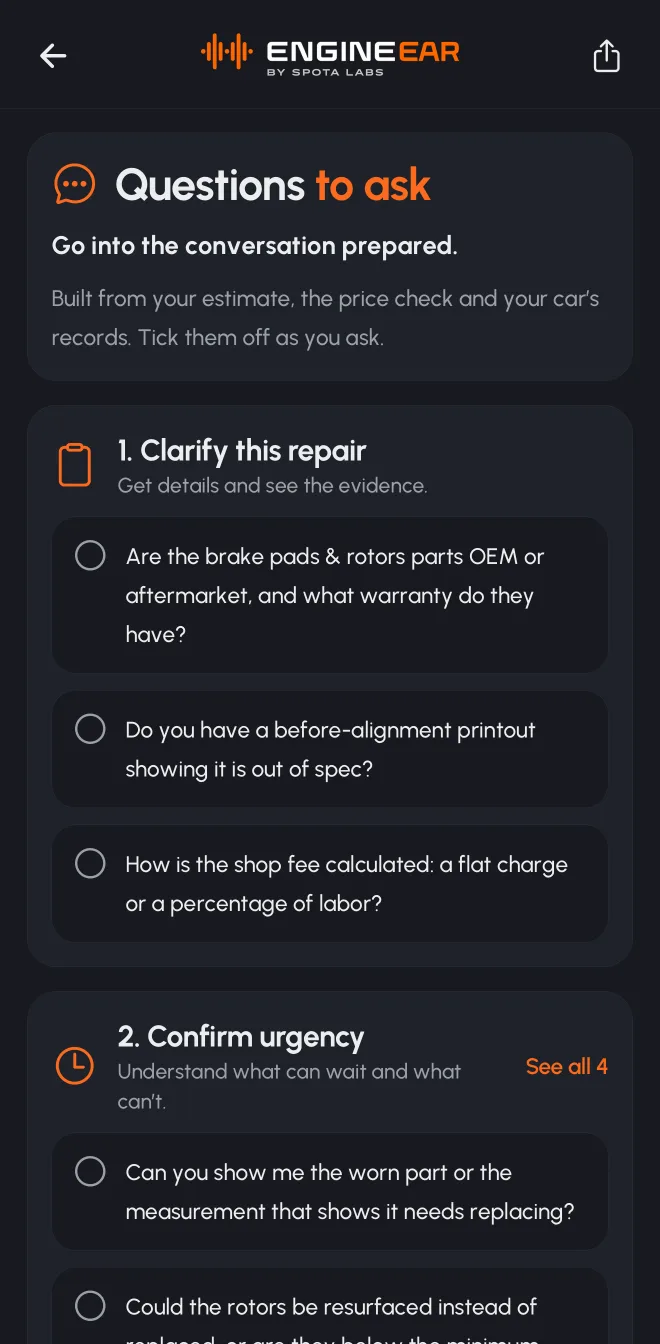
Repair Check sorts the work into safety-related items (brakes, tires, steering) and items the estimate marks as optional, and turns the whole thing into key takeaways. Then it builds a checklist of questions for your shop from your estimate, the price check and your car's records, so you go into the conversation prepared. You can tick them off as you ask.
Compare a second quote
If you decide to get a second quote, Repair Check can share the work list without the prices, so the next shop quotes the same job. Scan the second estimate and compare the two side by side.
After the repair
When the work is done, record it from the estimate lines, or scan the final invoice into the Vault. Either way, it becomes part of the car's service history, so the next time someone recommends a flush or new pads, you'll know exactly when they were last done. You can also ask your car's companion about any estimate or old invoice in plain language.
The short version
- Get a written, itemized estimate.
- Split it into the repair, the extra findings and the recommendations.
- Check the labor hours, not just the rate.
- Ask which items are safety-related and which can wait.
- Price the biggest lines for your exact car.
- Ask to see the evidence, and ask for your old parts.
- Get a second quote for the same list of work.
Most mechanics are honest people doing hard work, and a good one will welcome these questions. The aim is simply to approve repairs knowing what you're paying for.
Try Repair Check in EngineEar. Free accounts include one Repair Check, and Turbo includes eight a month.
- engineear
- repair check
- car repair
- estimates
- guide
EngineEarListen to your engine. Look after your car.