Guide4 min read
Do you pay sales tax when you trade cars privately?
How sales and use tax usually works when two owners exchange cars: why each car is treated as a sale, how states value it, even exchanges, the dealer trade-in credit, and what to check before you register.
 By SpotaLabs Team
You've agreed a trade, shaken hands, and you're about to register your new car. Then the question hits: do I owe sales tax on a car I didn't really buy?
Usually, yes, though the amount and how it's worked out depend heavily on where you live. This guide explains the general patterns in the US, so you know what to expect and what to ask your DMV or tax agency.
Why a trade usually counts as a sale
To most states, a car trade is two sales at once. You transfer your car to the other owner, and they transfer theirs to you. When you register the car you received, the state treats you as a buyer and typically collects sales or use tax on it, just as it would if you'd paid cash.
The other owner does the same when they register your car.
How the taxable value is decided
This is where states differ most. Common approaches include:
- The price on the bill of sale. In a trade, that's usually the agreed value of the car you received, or sometimes only the cash that changed hands.
- A standard or "presumptive" value. Some states use a book value for private sales, and tax you on that or on the sale price, whichever is higher, to stop people writing $1 on the bill of sale.
- Special rules for even exchanges. A few states treat a straight car-for-car trade with no money involved differently. Texas, for example, charges a flat $5 even-exchange tax instead of a percentage of the car's value.
- Exemptions. Transfers between family members, gifts and inheritances often have their own rules, but a trade between strangers usually doesn't qualify.
Because of this, write an accurate bill of sale for each car, with the agreed value of each and any cash paid. Understating values to save tax is tax fraud, and states that use book values often catch it anyway.
The dealer trade-in credit, and why it matters here
If you trade in at a dealer, most states only tax the difference between the price of the car you're buying and your trade-in allowance. That "trade-in credit" can be worth thousands of dollars, and it's the strongest financial argument for trading in at a dealer.
Private trades generally don't get that credit in the same form, because there's no dealer sale to offset. On the other hand, a few states, California among them, don't give a trade-in credit even at dealers, so the dealer route has no tax advantage there.
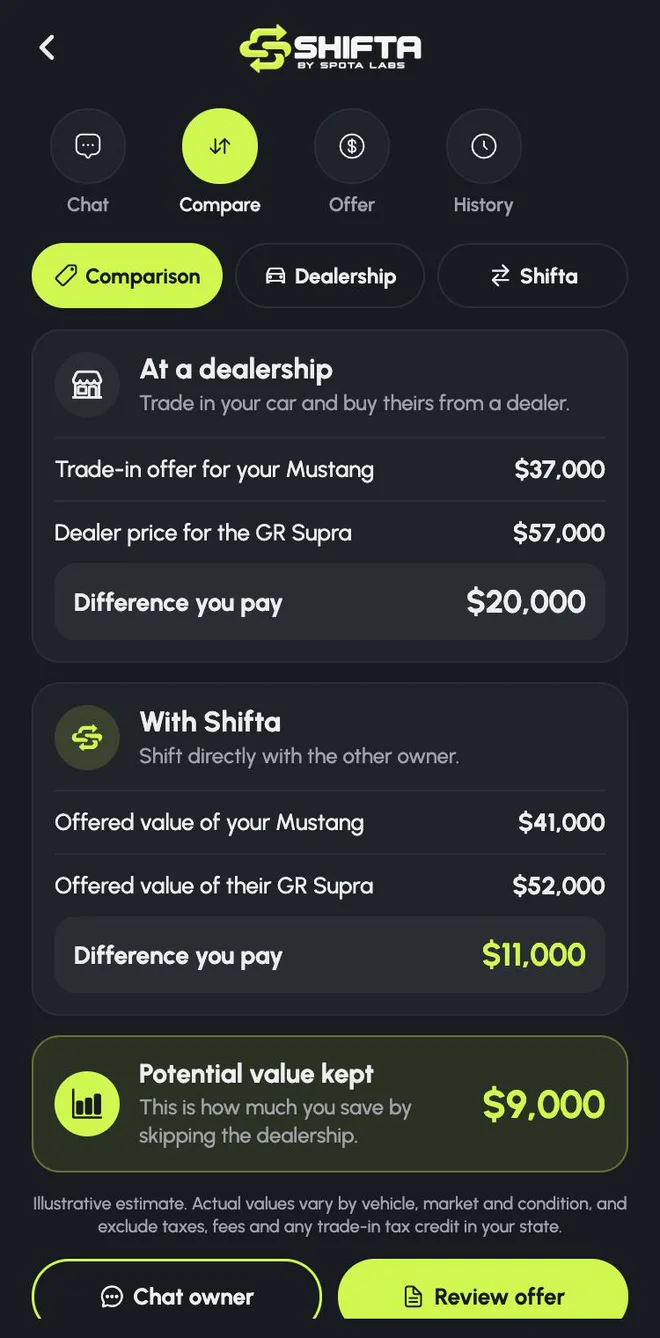
When you compare a dealer deal with a direct trade, include the tax on both sides. We do the full comparison in Dealership trade-in vs trading privately.
A simple example
Say you trade a car worth $30,000 for one worth $40,000, and you add $10,000 cash. In a state that taxes the value of the car you receive at 6%:
- You register a $40,000 car and might owe around $2,400.
- The other owner registers a $30,000 car and might owe around $1,800.
In a state that only taxes the cash portion, or that has an even-exchange rule, the numbers could be much lower. In a dealer deal with a trade-in credit, you'd pay tax on the $10,000 difference only, about $600, but you'd usually also lose money on the trade-in itself and pay a dealer's retail price.
The numbers are only illustrations. Use your own state's rate and rules.
What to check before the trade
- How your state taxes private vehicle transfers: on the sale price, a book value, or the cash portion.
- Whether your state has special rules for even exchanges or trades.
- Local add-ons: county or city taxes, title fees, registration fees and plate fees.
- Deadlines. Many states charge penalties if you register or pay tax late.
- What documents the DMV wants: usually the signed title, a bill of sale, an odometer disclosure, proof of insurance and ID.
Budget for the tax as part of the deal, the same way you'd budget for the cash difference. It's not a reason to avoid a good trade, but it shouldn't be a surprise either.
Where Shifta fits
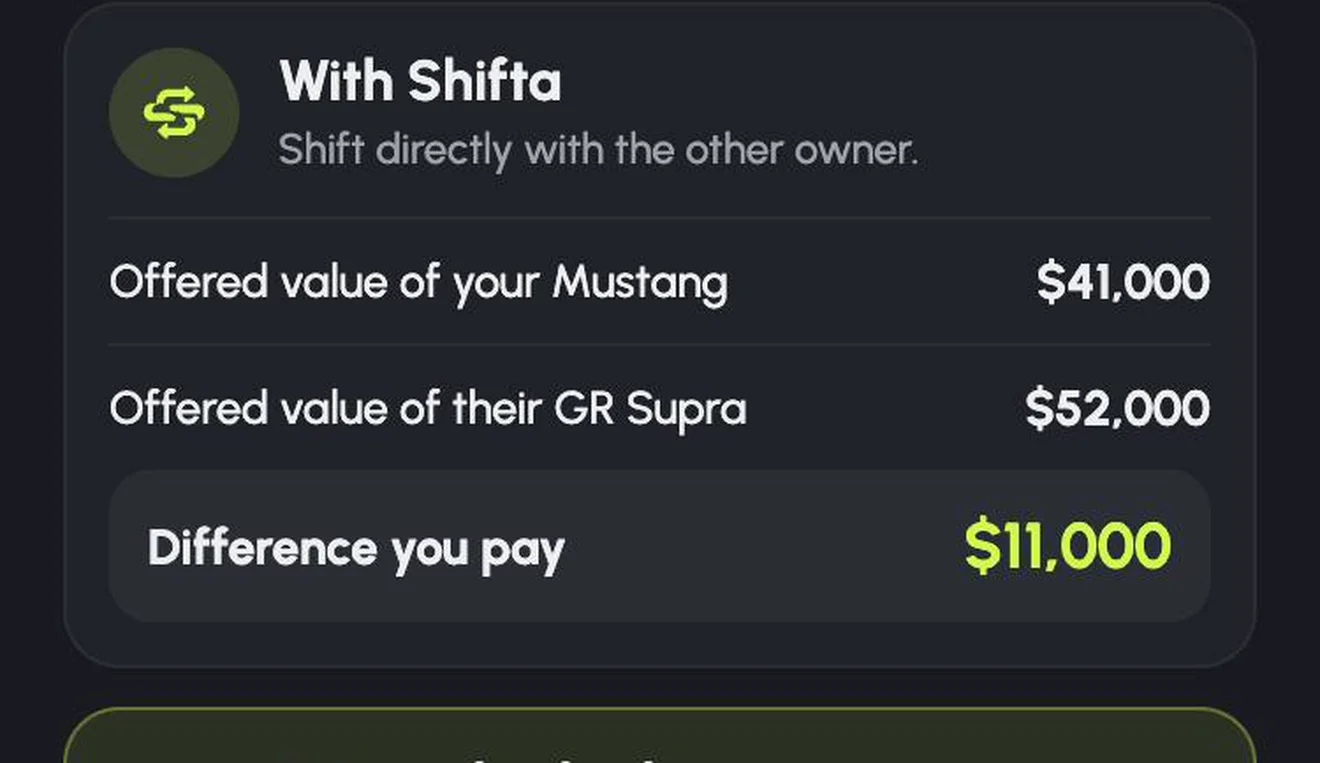
Shifta shows estimated values for both cars and the cash difference, and its dealership comparison is clearly labeled as excluding taxes, fees and any trade-in tax credit in your state, so you know to add them yourself. Once an offer is accepted, a Secure Shift tracks the title and registration transfer as the final step of the exchange.
For the rest of the paperwork, see Can you swap cars with someone? Legality, title transfer and paperwork.
- shifta
- car trade
- sales tax
- registration
- guide
ShiftaSkip the sale. Trade into your next car.