Guide5 min read
Dealership trade-in vs trading privately: how much are you leaving on the table?
Why dealer trade-in offers come in low, where the money goes in a trade-in deal, how the sales tax credit changes the math, and when trading directly with another owner keeps more in your pocket.
 By SpotaLabs Team
You walk into a dealership with a car you've looked after, and the trade-in offer lands a few thousand below what you expected. The salesperson is friendly about it. The used-car manager "ran the numbers". You can take it or leave it.
Most people take it, because the alternative, selling privately and then buying separately, sounds like a lot of work. This guide is about what that convenience actually costs, why dealer offers come in where they do, and how to work out whether a direct trade with another owner is worth it for you.
Three prices for the same car
Every used car has (at least) three prices, and most confusion about trade-ins comes from mixing them up:
- Trade-in value: what a dealer pays you for your car. The lowest of the three.
- Private-party value: what another owner would pay you directly. Usually in the middle.
- Retail price: what a dealer charges for the same car on its lot. The highest.
When you trade in and buy from a dealer, you sell at the bottom of that range and buy at the top. When you trade directly with another owner, both cars change hands at private-party values.
Why dealer trade-in offers come in low
A dealer that takes your car has to turn it into profit, and that costs money:
- Reconditioning. Detailing, tires, brakes, paint touch-ups, fixing whatever the inspection finds.
- Holding costs. The car sits on the lot, financed, insured and depreciating, until it sells.
- Risk. If the car has a problem nobody spotted, the dealer eats it. If it doesn't sell, it goes to auction at a loss.
- Profit. The dealership is a business.
So the trade-in offer is roughly what the dealer thinks it can sell your car for, minus all of that. On a typical car, that gap between trade-in and private-party value is often thousands of dollars, and more on expensive or enthusiast cars.
The other half: the car you're buying
Trade-ins get the attention, but the second margin matters just as much. The car you buy from the dealer is priced at retail, which covers the same reconditioning, holding costs and profit on that car. Add dealer fees and add-ons, and the gap between what the other car is worth and what you pay for it can be as big as the gap on your trade-in.
Put the two together and you can see why the total cost of a trade-in deal surprises people.
A worked example
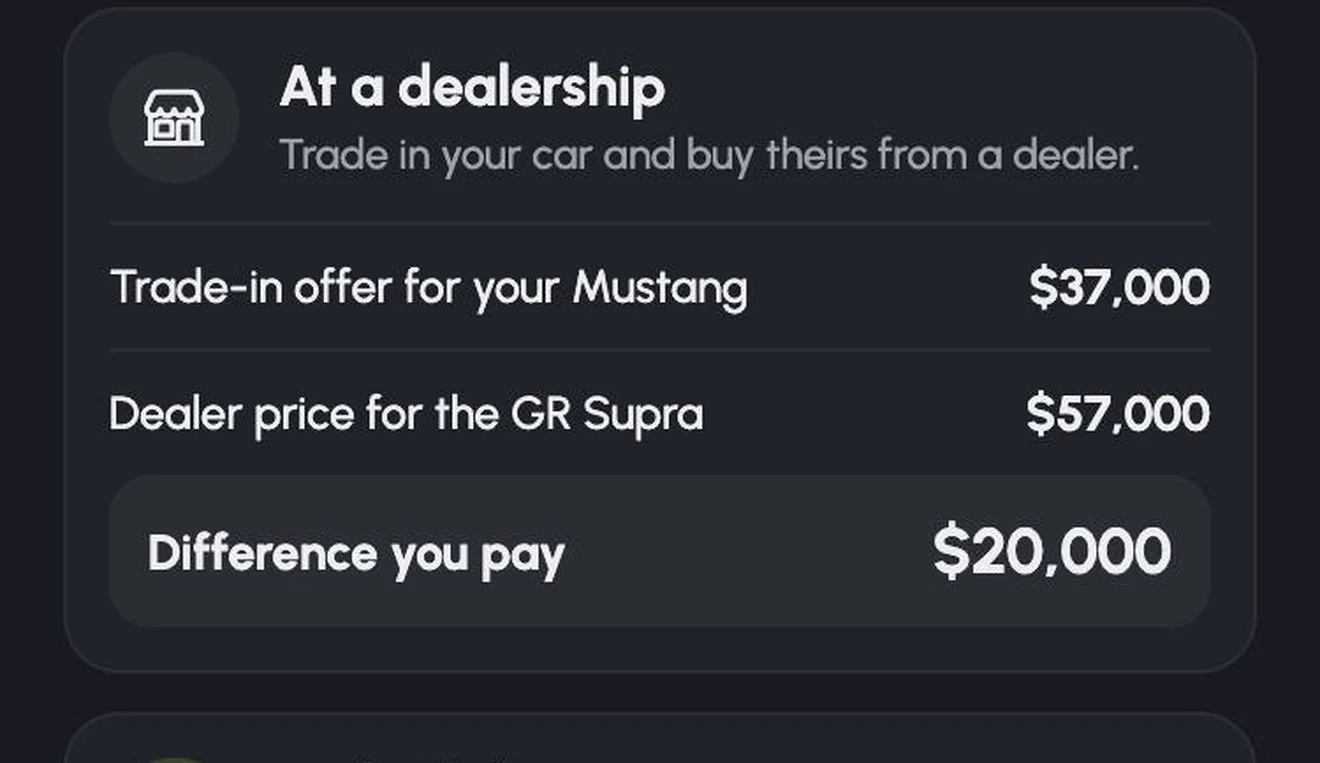
Here's how Shifta lays it out, using sample numbers from a 2022 Ford Mustang GT traded for a 2022 Toyota GR Supra:
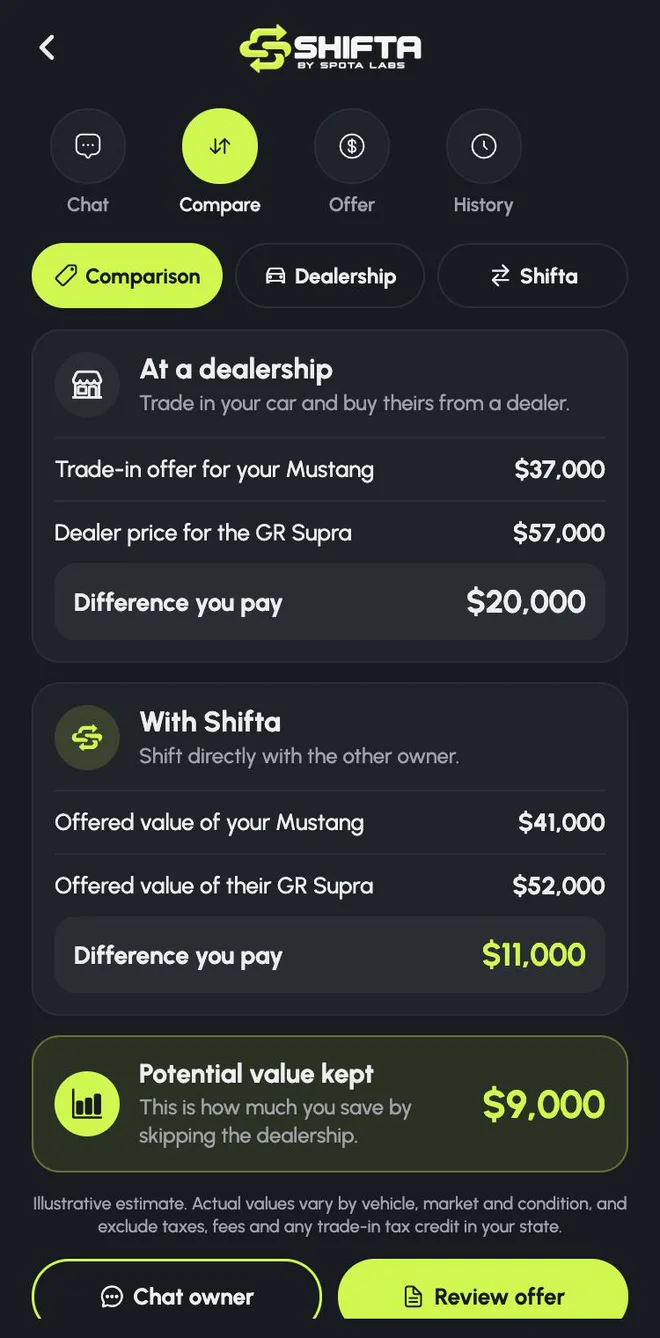
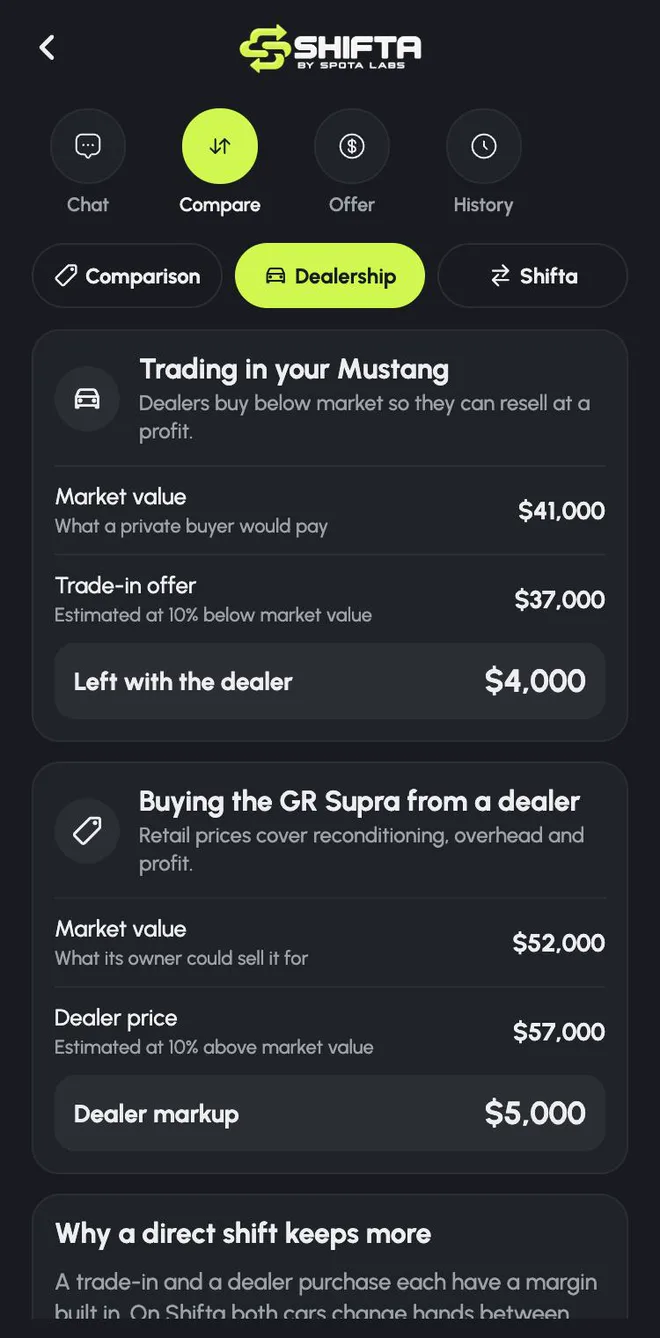
- At a dealership: a $37,000 trade-in offer for the Mustang, and a $57,000 dealer price for the Supra. You pay $20,000.
- Directly between owners: the Mustang at $41,000 and the Supra at $52,000. You pay $11,000.
- The difference: about $9,000 that stays with the two owners instead of going to the dealership.
Shifta's comparison is an illustrative estimate. It assumes a trade-in about 10% below market value and a dealer price about 10% above it. Real numbers depend on the car, the market, condition and the dealer, and they don't include taxes, fees or any trade-in tax credit in your state. But it's a useful way to see the shape of the deal before you walk into a showroom.
The trade-in tax credit: the dealer's best argument
In most US states, when you trade a car in at a dealer, you only pay sales tax on the difference between the new car's price and your trade-in. Trade in a $30,000 car against a $50,000 car and you're taxed on $20,000, not $50,000. At a 7% tax rate, that saves $2,100.
That credit is real, and it narrows the gap. A handful of states, including California, don't offer it, so there the dealer route loses that advantage entirely. Private trades are taxed differently again, and it varies a lot by state. We explain it in Do you pay sales tax when you trade cars privately?
The honest way to compare is: private-trade savings minus any tax credit you'd give up. On many cars, especially enthusiast cars where dealer margins are wide, the direct trade still comes out well ahead.
When the dealer is the right call
Trading in still makes sense sometimes:
- You need a car today and can't wait to find the right match.
- Your car has problems you don't want to disclose to, or negotiate with, a private buyer. (A dealer will price them in either way.)
- The numbers are close. On a cheap car in a state with a generous tax credit, the convenience may be worth more than the difference.
- You want something new. New cars only come from dealers.
How to avoid leaving money on the table
Whichever route you choose:
- Know your private-party value before you hear any offer.
- Negotiate the two halves separately. Agree the price of the car you're buying, then the trade-in. Bundled "monthly payment" talk hides both.
- Get more than one trade-in offer. Online instant offers and other dealers are a useful benchmark.
- Price a direct trade. If there's an owner who has the car you want and wants yours, that's often the deal with the least money left on the table.
That last step is what Shifta is for. Add your car and what you'd accept, and you'll see owners whose cars fit your preferences and who want a car like yours, with both values and the difference up front.
New to trading privately? Start with How to trade your car for another car without a dealer.
- shifta
- trade-in
- dealership
- car value
- guide
ShiftaSkip the sale. Trade into your next car.